
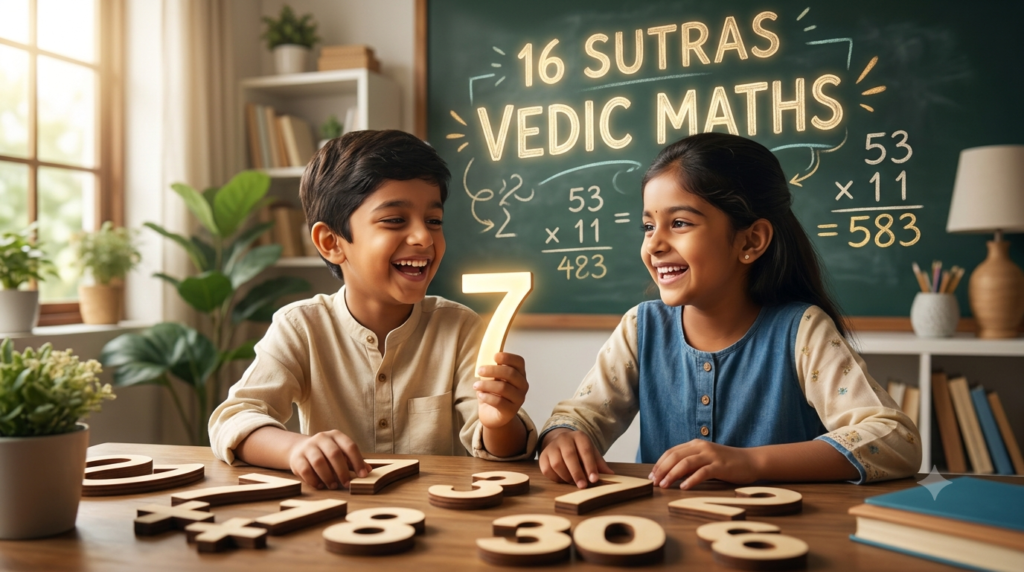
Ask any parent whose child dreads long division, and you’ll hear the same worry. Numbers feel slow, heavy, and stressful. Vedic Maths flips that story. It turns messy classroom sums into quick mental shortcuts, and once kids start spotting the patterns, arithmetic actually becomes fun. So what is Vedic Maths, really? This guide breaks down the ancient Indian mathematics behind it, the sutras that power it, the tricks kids love, and the real benefits of Vedic Maths for young learners and parents alike.
What is Vedic Maths?
Vedic Maths is a system of mental calculation techniques that make arithmetic faster, simpler, and more intuitive. Instead of the long, step-by-step methods taught in most schools, it uses a handful of guiding principles to help children recognize number patterns and solve problems in their heads.
The system rests on 16 core formulas known as sutras, plus 13 supporting sub-sutras. These aren’t random tricks. They’re a structured way of thinking about numbers that was rediscovered and compiled in the early 1900s by Jagadguru Swami Sri Bharati Krishna Tirthaji, drawing on ancient Indian mathematics. Here’s the thing worth remembering: Vedic Maths doesn’t replace school maths. It sits alongside it, giving kids a faster route to the same correct answer.
Where Traditional Maths Meets Vedic Mathematics
Traditional school math is brilliant for building deep conceptual understanding. It teaches the why. Vedic mathematics, on the other hand, sharpens the how, specifically the speed of getting to an answer. The two work best together. A child who understands why multiplication works and can also multiply two-digit numbers mentally in seconds has a real edge.
The Sutras of Vedic Maths Explained
The sutras of Vedic Maths are short aphorisms, each describing a mental strategy for a type of calculation. You don’t need to memorize all 16 to benefit. Most everyday speed comes from just a few. Below is a plain-English look at the ones kids use most.
Ekadhikena Purvena (By one more than the previous one): Perfect for squaring numbers ending in 5. To square 35, take the first digit 3, multiply it by one more than itself (3 times 4 equals 12), then tack on 25. Answer: 1225. Done in your head.
Nikhilam Navatashcaramam Dashatah (all from 9 and the last from 10): A base-number trick that makes multiplying numbers near 100 or 1000 almost effortless. Multiplying 98 by 97 becomes a quick two-step move instead of messy long multiplication.
Urdhva-Tiryagbhyam (Vertically and Crosswise): The general multiplication sutra. It lets a child multiply any two numbers using a criss-cross pattern, left to right, without stacking columns of carried digits.
Paravartya Yojayet (Transpose and adjust): Handy for division and for solving simple linear equations later on. When a child moves into algebra, this same principle reappears, which is one reason early exposure pays off for years.
Yavadunam (Whatever the deficiency): A fast squaring method for numbers close to a base like 100. To square 97, note the deficiency from 100 is 3, subtract it (97 minus 3 gives 94), then square the deficiency (3 squared is 09). The answer is 9409, reached in two clean steps.
Sankalana Vyavakalanabhyam (By addition and by subtraction): Useful for solving pairs of simultaneous equations quickly, a skill that becomes handy in higher grades.
These few short formulas cover a huge share of the calculations a school-age child faces. Master four or five, and the speed gains are immediate. There’s no need to rush through the entire list of sixteen; depth on a small set beats shallow familiarity with all of them.
Vedic Maths Tricks Kids Actually Love
Let me be honest. Kids don’t get excited about “systems.” They get excited about winning a race against a calculator. That’s exactly what good mental shortcuts feel like. Here are a few crowd-pleasers.
- Multiplying by 11: To multiply 52 by 11, split the digits (5 and 2), add them (5 plus 2 equals 7), and drop that sum in the middle. Answer: 572. Watch a nine-year-old do this once and they’re hooked.
- Squaring numbers ending in 5: Covered above with the sutra, but it bears repeating because it’s the trick that converts skeptical kids. 65 squared? Six times seven is 42, add 25, and you get 4225.
- Instant subtraction from powers of 10: Subtracting 4678 from 10000 without borrowing. Take each digit from 9, and the last from 10. The answer, 5322, appears almost instantly.
- Multiplication near a base: Numbers like 96 times 94 become simple when you work from the base of 100.
The beauty of these Vedic Maths tricks is that they build number confidence fast. A child who can beat the family calculator at the dinner table stops fearing math and starts enjoying it.
Benefits of Vedic Maths for Children
The benefits of Vedic Maths go well beyond party-trick speed. When it’s taught well, this approach reshapes how a child relates to numbers. Here’s what parents and teachers notice most.
- Faster, sharper calculations: By turning multi-step sums into short mental moves, kids reach answers quicker and check homework in seconds rather than reworking whole problems.
- Stronger mental math for kids: Because so much is done in the head, working memory and concentration get a genuine workout. This is where mental math for kids really develops. The brain learns to hold and manipulate numbers rather than lean on paper for everything.
- An edge in competitive exams: Speed and accuracy matter enormously in timed tests. Olympiad rounds, aptitude papers, and entrance exams all reward a child who can clear arithmetic quickly and spend the saved time on tougher, logic-heavy questions.
- Less math anxiety, more confidence: This one matters most, in my view. When a child sees there’s a quick, clear path to an answer, math stops feeling like a wall. Confidence grows with every correct sum, and that confidence spills into the classroom.
- Skills that transfer: The pattern-spotting habit Vedic mathematics builds support for algebra, estimation, and number reasoning later on. It’s a foundation, not a dead end.
- Real-world use: Splitting a bill, checking change, and estimating a discount while shopping. The mental math for kids that Vedic methods build shows up in everyday life, quietly making your child more capable with numbers.
Vedic Maths for Kids: When and How to Start
A common question from parents: what’s the right age? Most children are ready once they’re comfortable with basic addition and subtraction, usually around ages 7 to 9. Starting Vedic Maths for kids early helps build number sense before school arithmetic gets heavier. That said, there’s no upper limit. Teens preparing for competitive exams gain just as much.
Below is a simple age-based roadmap parents can follow.
| Age / Grade | Learning Focus | Key Tips |
| Ages 6–8 (Grades 1–3) | Basic number familiarity | Simple mental addition and subtraction games; gentle pattern-based ideas; visual aids and short puzzles. Keep it playful. |
| Ages 9–12 (Grades 4–6) | Calculation fluency | Multiplication shortcuts and squaring; encourage mental solutions before writing; short-timed challenges for fun. |
| Ages 13+ (Grades 7 and above) | Broader application | Verify algebra and arithmetic with Vedic methods, practice mental estimation, and speed up exam-style questions. |
The golden rule for Vedic Maths for kids is simple. Keep sessions short, turn drills into games, and let children explain their mental steps out loud. Explaining reinforces the pattern and makes it stick.
How Parents Can Support Learning at Home
You don’t need a math degree to help your child here. A few simple habits at home make a surprising difference, and most take under ten minutes.
Turn the daily commute into a number game. Ask your child to add up the digits on a passing number plate or to double the price of something in a shop window. Small, casual practice keeps the pattern-spotting muscle active without feeling like homework.
Praise the method, not just the answer. When a child explains how they reached a result, they lock the technique into memory. Ask, “How did you do that so fast?” and let them teach you back. Kids love playing teacher, and explaining a shortcut out loud is one of the best ways to cement it.
Keep a small win visible. A sticker chart, a running tally of “calculator races” won, or a simple notebook of solved puzzles gives young learners something to feel proud of. Confidence is half the battle, and visible progress fuels it.
Resist the urge to correct too quickly. If a child makes a slip, let them find it themselves by re-checking with a shortcut. Self-correction builds far more resilience than a parent jumping in with the right number.
Common Mistakes and Misconceptions
A quick word of caution, because a few myths trip up new families. First, these shortcuts are not magic that works equally on every problem. Some sums genuinely suit the pattern methods; others are quicker than the standard way. Teaching a child to pick the right tool for the job matters more than forcing a shortcut everywhere.
Second, speed is not the whole point. A learner who computes fast but doesn’t understand why an operation works has a shaky foundation. Pair these techniques with solid school concepts, and the combination is powerful. Used alone, speed tricks can paper over gaps.
Third, early frustration is normal. A method can feel slower than the familiar written approach for the first week or two, simply because it’s unfamiliar. That’s expected. Push gently through that phase, and the fluency arrives.
Comparing the Three Popular Math Approaches
Parents often weigh Vedic maths against the abacus and standard school maths. Each has a job. The table below lays out how they differ.
| Factor | Vedic Maths | Abacus | Traditional Math |
| Core idea | Mental techniques based on number patterns and sutras | Physical bead tool to visualize numbers | Written, step-by-step school methods |
| Tools needed | None—mostly mental | Device needed at first | Paper and pencil |
| Speed | Very fast once patterns click | Fast with practice | Slower due to written steps |
| Best for | Multiplication, squares, mental arithmetic | Basic arithmetic | Full curriculum incl. algebra, geometry |
| Conceptual depth | Technique over deep theory | Calculation-focused | Strongest conceptual understanding |
A Quick Weekly Practice Plan
Consistency beats intensity. A child practicing 15 minutes a day will outpace one who crams for an hour once a week. Here’s a light weekly structure.
- Monday & Tuesday. Warm up with multiplication-by-11 and doubling drills.
- Wednesday. Squaring numbers ending in 5, five problems, timed.
- Thursday. Base-number multiplication near 100.
- Friday. Mixed review, played as a race.
- Weekend. One fun challenge, maybe beating a parent at mental sums. Keep it light and celebratory.
Final Thoughts
So, what is Vedic Maths in a sentence? It’s a fast, pattern-based system of mental calculation rooted in ancient Indian mathematics that helps children compute quicker and fear numbers less. The sutras give kids clever shortcuts, the tricks make practice genuinely fun, and the benefits of Vedic Maths, from stronger mental maths for kids to real exam confidence, last well beyond the classroom.
If your child is ready to swap maths dread for maths delight, Vedic Maths for kids is one of the smartest first steps you can take. Start small, keep it playful, and watch their confidence with numbers grow.
Frequently Asked Questions
Is Vedic Maths easy to learn?
Yes. Once children grasp the pattern behind a sutra, the calculations become short mental steps. With regular practice the methods turn intuitive, and calculation speed climbs noticeably within weeks.
Do you need to memorize all 16 sutras?
No. Many everyday calculations rely on just a few of the sutras of Vedic Maths. Learning four or five of the most practical ones is usually enough to see a real jump in mental math speed.
Is Vedic Maths only for Indian children?
Not at all. Although this ancient Indian mathematics was compiled by an Indian scholar, the techniques are universal. Children across the world use them to sharpen mental calculation.
Does Vedic Maths replace school maths?
No. It’s a supplement, not a substitute. School math builds conceptual understanding and problem-solving logic. Vedic mathematics adds speed on top. The two together are far stronger than either alone.
What age should kids start Vedic Maths?
Most children are ready around ages 7 to 9, once they’re comfortable with basic addition and subtraction. Starting early builds number sense before arithmetic grows more demanding.
Can Vedic Maths help in competitive exams?
Yes. Faster arithmetic saves precious minutes in timed papers, letting students focus on harder, reasoning-based questions. That’s why many exam-prep programs include Vedic math tricks.