
How Communication Skills Are Developed Through the Junior Skill Development Program at SkillUp Juniors
Every child has ideas, thoughts and feelings to share. However, some children may hesitate to speak in front of others, struggle to express their ideas clearly or feel nervous when answering questions.
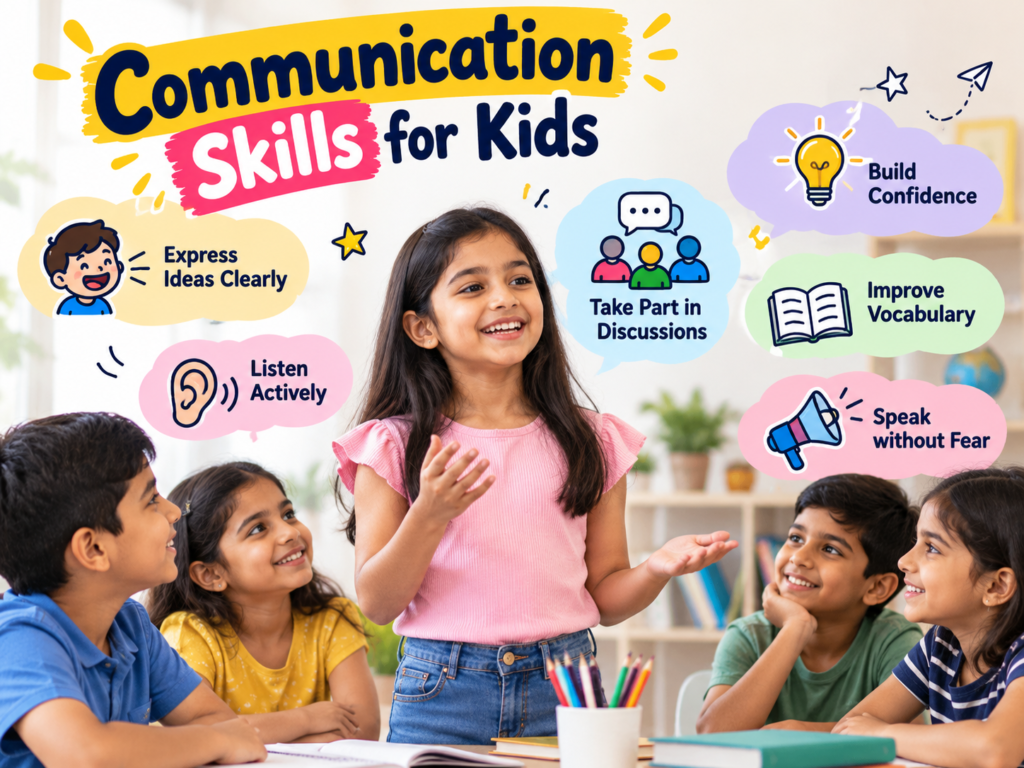
Developing communication skills for kids is about more than speaking English fluently. It includes expressing ideas confidently, listening carefully, asking meaningful questions, understanding others and communicating respectfully in different situations.
At SkillUp Juniors, the Junior Skill Development Program aims to help children practise these essential life skills through interactive sessions, guided activities and opportunities to participate.
Why Are Communication Skills Important for Children?
Communication is an essential skill that children use at school, at home and in their everyday lives.
Strong communication skills can help children:
- Express their thoughts, needs and feelings clearly.
- Participate more actively in classroom discussions.
- Ask questions when they need help.
- Listen to and understand other people’s viewpoints.
- Share ideas during group activities.
- Prepare for presentations and public speaking.
- Build positive relationships with friends, teachers and family members.
Children develop these abilities gradually through regular practice, encouragement and constructive feedback.
How SkillUp Juniors Develops Communication Skills for Kids
The Junior Skill Development Program provides opportunities for children to practise communication in different ways. Here are some activities that can support their development.
1. Storytelling and Personal Expression
Storytelling encourages children to organise their thoughts and express them in a meaningful sequence.
Children can practise narrating a story, describing an experience, explaining what happened during their day or creating their own stories.
These activities help them practise:
- Speaking in complete sentences.
- Arranging ideas in a logical order.
- Using descriptive words.
- Explaining events clearly.
- Speaking in their own words.
For example, a child may be asked to narrate a favourite story or describe a memorable experience in two to three minutes.
2. Public Speaking and Confidence-Building Activities
Some children know what they want to say but feel nervous when speaking in front of a group.
Guided speaking activities give them opportunities to practise in a supportive environment. Children may speak about familiar topics, introduce themselves, share their opinions or deliver a short presentation.
Through repeated practice, they can work on:
- Speaking audibly and clearly.
- Maintaining appropriate eye contact.
- Organising their thoughts before speaking.
- Reducing dependence on memorised sentences.
- Becoming more comfortable speaking in front of others.
The aim is not to make every child an expert speaker immediately. It is to help each child become more comfortable expressing ideas at their own pace.
3. Group Discussions and Sharing Ideas
Group discussions teach children that communication involves both sharing their own thoughts and understanding the thoughts of others.
During a guided discussion, children can learn to explain their opinions, respond to questions, agree or disagree politely and wait for their turn to speak.
For example, children might discuss a topic such as “Should children have a daily reading habit?” Each child gets an opportunity to share a viewpoint and listen to different perspectives.
This helps children practise respectful communication, reasoning and teamwork.
4. Listening and Understanding Others
Good communication starts with good listening.
Children need opportunities to listen carefully, understand instructions, identify important information and respond appropriately.
Listening-based activities may include:
- Following multi-step instructions.
- Listening to a short story and answering questions.
- Retelling information in their own words.
- Identifying key points from a conversation.
- Waiting until another speaker has finished before responding.
These activities encourage children to pay attention, process information and respond thoughtfully rather than simply waiting for their turn to speak.
5. Asking Questions and Expressing Opinions
Children should feel comfortable asking questions when they are curious or confused.
In guided learning activities, children can practise asking relevant questions, explaining why they think something and giving reasons for their opinions.
For example, after reading a short passage, a child might be asked:
- What did you learn from this passage?
- Which part interested you the most?
- Why do you agree or disagree with the character?
- What would you do differently?
Such questions encourage children to think independently and express their ideas more clearly.
6. Vocabulary and Clear Sentence Formation
A child does not need complicated words to communicate effectively. The important thing is to choose suitable words and organise them clearly.
Activities involving descriptions, picture-based conversations, reading aloud and sentence-building can help children practise vocabulary and sentence formation.
Children can start by describing a picture, explaining an object or summarising a short story. Gradually, they can work towards expressing more detailed thoughts.
These activities can support both spoken communication and language development.
7. Everyday Communication and Role-Play
Children also need to practise communication in familiar real-life situations.
Role-play activities allow them to act out everyday conversations, such as:
- Introducing themselves to someone new.
- Asking a teacher for clarification.
- Requesting help politely.
- Giving directions.
- Participating in a conversation.
- Expressing disagreement respectfully.
These exercises give children a safe space to practise choosing appropriate words, speaking politely and responding to different situations.
How Does the Junior Skill Development Program Help Children Practise These Skills?
At SkillUp Juniors, the Junior Skill Development Program focuses on learning beyond memorising information. Interactive activities can give children opportunities to think, speak, listen, participate and apply what they learn.
The communication-development process can be understood in four stages:
Stage 1: Express — Children practise sharing their thoughts and experiences.
Stage 2: Participate — They take part in discussions, storytelling and guided speaking activities.
Stage 3: Interact — They practise listening, asking questions and responding respectfully.
Stage 4: Reflect and improve — They receive guidance and work on making their communication clearer and more effective.
Progress looks different for every child. Regular practice, supportive guidance and opportunities to participate are important for developing these skills over time.
What Can Parents Do at Home to Improve Communication Skills?
Parents can reinforce communication practice through simple daily activities.
- Ask open-ended questions: Instead of asking only “How was school?”, ask “What was the most interesting thing you learned today?”
- Encourage storytelling: Let your child describe a favourite memory, book or experience.
- Listen without interrupting: Give children time to finish their thoughts.
- Play conversation games: Take turns describing objects, guessing words or explaining simple ideas.
- Encourage respectful opinions: Allow children to disagree politely and explain their reasons.
- Appreciate effort: Recognise when your child tries to speak, asks a question or expresses an idea clearly.
Avoid comparing children with one another. Encouragement and consistent opportunities to practise can help children feel more comfortable communicating.
Who Can Benefit From a Junior Skill Development Program?
A structured skill development program may be useful for school-age children who want opportunities to practise communication, public speaking, listening, critical thinking and other practical life skills.
Children who are naturally talkative can also benefit by learning to listen carefully, organise their ideas and communicate respectfully.
The goal is not to change a child’s personality. It is to help children develop skills they can use in everyday situations.
Help Your Child Build Essential Life Skills With SkillUp Juniors
Academic learning is important, but children also benefit from opportunities to express themselves, work with others, ask questions and communicate their ideas.
The SkillUp Juniors Junior Skill Development Program is designed to support children’s overall skill development through guided learning and practical activities.
Give your child opportunities to practise, participate and grow one step at a time.
Interested in learning more about SkillUp Juniors?
Contact SkillUp Juniors to enquire about the Junior Skill Development Program and available batches.
Contact: 9353387479
Frequently Asked Questions
1. How can communication skills be developed in children?
Communication skills can be developed through storytelling, conversations, listening exercises, group discussions, role-play, reading and public speaking practice. Regular encouragement helps children improve gradually.
2. At what age should children start developing communication skills?
Children begin developing communication skills from early childhood. School-age children can continue strengthening these skills through age-appropriate activities, discussions and everyday conversations.
3. Does communication mean speaking English fluently?
No. Communication includes expressing ideas clearly, listening carefully, asking questions, understanding others and responding appropriately. English fluency is only one aspect of communication.
4. What is the Junior Skill Development Program at SkillUp Juniors?
The Junior Skill Development Program is intended to help children practise practical skills beyond textbook learning. Communication, public speaking, critical thinking and other life skills can be developed through guided and interactive learning activities.
5. How can parents support communication skills at home?
Parents can encourage children to share their experiences, ask questions, explain their opinions, tell stories and participate in family conversations. Listening patiently and appreciating effort can make practice more comfortable.