
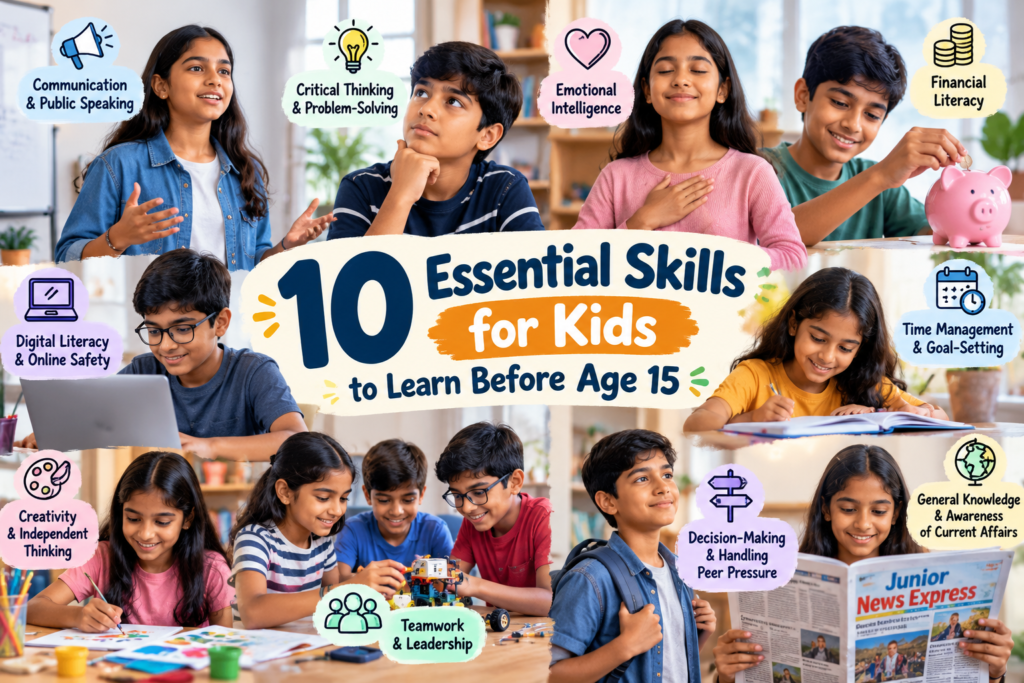
10 Essential Skills for Kids to Learn Before Age 15
Every child has unique talents, interests and abilities. While school education helps children build academic knowledge, they also need practical skills to communicate confidently, make thoughtful decisions, manage emotions and handle everyday challenges.
Understanding the 10 essential skills for kids can help parents create practical learning opportunities that build confidence, independence and responsible decision-making.
The years before turning 15 are a valuable time for children to practise these abilities and gradually become more independent. Parents can support this development through everyday conversations, family activities, reading, group discussions and real-life experiences.
In this guide, we explore 10 essential skills for kids to develop before age 15, along with practical ways parents can help children build them at home.
Why Are Life Skills Important for Children?
The 10 essential skills for kids discussed in this guide encourage confidence, independence, thoughtful decisions and positive relationships.
Life skills help children apply what they learn to real situations. For example, knowing how to solve a mathematics problem is useful, but learning how to manage pocket money, communicate an idea or handle a disagreement is equally valuable in everyday life.
Developing these skills can help children:
- Express their thoughts and feelings clearly.
- Approach challenges with confidence.
- Work cooperatively with others.
- Make informed and responsible decisions.
- Develop healthy habits and independence.
- Understand the world around them.
Children do not develop every skill at the same speed. Parents should focus on consistent practice, encouragement and age-appropriate responsibilities rather than expecting perfection.
Practising the 10 essential skills for kids regularly can help children apply their learning to real-life situations.
1. Communication and Public Speaking
Communication is one of the most useful skills a child can develop. It helps children express ideas, ask questions, share feelings and interact with teachers, friends and family members.
Public speaking also gives children opportunities to organise their thoughts and speak in front of others.
How parents can help:
- Encourage children to describe their day in their own words.
- Ask them to explain a favourite story, hobby or topic.
- Play storytelling and role-playing games.
- Let them give short presentations during family gatherings.
- Teach them to listen without interrupting.
Try this activity: Ask your child to speak for two minutes about a favourite book, person or hobby. Encourage them to speak clearly and organise their ideas. Celebrate their effort rather than correcting every mistake.
2. Critical Thinking and Problem-Solving
Children encounter problems every day, from completing a challenging assignment to resolving a disagreement with a friend. Critical thinking helps them examine information, consider alternatives and make reasoned decisions.
Instead of immediately giving children answers, parents can encourage them to think through a problem.
How parents can help:
- Ask open-ended questions such as “Why do you think that happened?”
- Encourage children to explain how they reached an answer.
- Use puzzles, riddles, strategy games and brain teasers.
- Discuss different ways to solve everyday problems.
- Help children distinguish facts from guesses.
Try this activity: Present a simple situation: “You have an hour to finish your homework, pack your schoolbag and prepare for tomorrow. How would you plan your time?” Ask your child to suggest a solution and explain why it might work.
3. Emotional Intelligence and Self-Awareness
Emotional intelligence involves recognising feelings, understanding how emotions affect behaviour and responding to other people with empathy.
Children may experience frustration, disappointment, nervousness or excitement as they grow. Learning to identify these emotions can help them communicate their needs and handle difficult situations more constructively.
How parents can help:
- Talk openly about different emotions.
- Encourage children to describe how they feel.
- Teach simple calming strategies, such as slow breathing or taking a short break.
- Discuss how other people might feel in a situation.
- Model respectful ways of handling disagreements.
Try this activity: At the end of the day, ask your child: “What made you happy today? Was anything difficult? What could help if it happens again?” Listen patiently without judging their answers.
4. Financial Literacy and Money Management
Financial literacy helps children understand money, spending, saving and making choices within a budget. Learning these concepts early can help them become more thoughtful about everyday financial decisions.
Children do not need to manage large amounts of money to begin learning. Simple activities using pocket money or pretend shopping can introduce important concepts.
How parents can help:
- Explain the difference between needs and wants.
- Help children set a small savings goal.
- Discuss prices while shopping.
- Teach them to compare options before buying something.
- Introduce simple budgeting using pocket money.
Try this activity: Give your child a pretend budget of ₹500 and ask them to plan how they would divide it between a necessary purchase, savings and an optional treat. Discuss their choices together.
The goal is not to encourage children to spend independently without guidance, but to help them understand the consequences of financial choices.
5. Time Management and Goal-Setting
Time management helps children organise their activities, meet responsibilities and make time for learning, play and rest.
Goal-setting teaches children to break a larger task into smaller, manageable steps. These abilities can also help them become more independent as they grow older.
How parents can help:
- Create a simple daily routine with your child.
- Use a checklist for homework and school preparation.
- Break large assignments into smaller tasks.
- Encourage realistic short-term goals.
- Help children reflect on what worked and what needs changing.
Try this activity: Ask your child to choose one goal for the coming week, such as reading for 15 minutes daily or organising their study table. Write down the steps and review progress together at the end of the week.
Remember that routines should be flexible enough to accommodate rest, family time and unexpected changes.
6. Creativity and Independent Thinking
Creativity is not limited to drawing or painting. It also involves generating ideas, exploring possibilities and approaching familiar situations in new ways.
Children benefit from opportunities to experiment, ask questions and make choices without always being told exactly what to do.
How parents can help:
- Provide time for drawing, crafts, music, writing and imaginative play.
- Encourage children to invent stories or games.
- Ask them to suggest alternative solutions to a problem.
- Allow them to make age-appropriate choices.
- Focus on effort and experimentation rather than perfect results.
Try this activity: Give your child five everyday objects and ask them to invent a new game using those objects. Let them explain the rules and demonstrate how to play.
The aim is to encourage curiosity and original thinking rather than to produce a perfect result.
7. Teamwork, Leadership and Cooperation
Teamwork helps children understand how to share responsibilities, respect different opinions and work towards a common goal. Leadership involves taking responsibility, helping others and making thoughtful decisions—not simply telling people what to do.
These abilities can develop through family activities, sports, classroom projects and group discussions.
How parents can help:
- Encourage children to participate in team games.
- Give siblings shared household responsibilities.
- Teach them to listen to different viewpoints.
- Help them resolve disagreements respectfully.
- Allow them to take turns leading simple activities.
Try this activity: Plan a family activity, such as preparing a meal or organising a small celebration. Assign age-appropriate tasks and let children help coordinate the work.
Afterwards, discuss how everyone contributed and what the family could do differently next time.
8. Decision-Making and Handling Peer Pressure
As children grow, they increasingly face choices involving friendships, activities, online behaviour and personal boundaries. Learning to evaluate options can help them make safer and more responsible decisions.
Children also need to understand that they can disagree respectfully, say no to uncomfortable requests and ask a trusted adult for help.
How parents can help:
- Discuss possible outcomes before making a decision.
- Encourage children to consider safety, fairness and consequences.
- Practise saying no in uncomfortable situations.
- Help children identify trusted adults they can approach.
- Create an environment where children can share mistakes without fear of humiliation.
Try this activity: Discuss a fictional situation: “Your friends want you to make fun of another student to fit in with the group. What could you do?” Explore several possible responses and their consequences.
Avoid expecting children to handle serious bullying, threats or unsafe situations alone. They should know when to seek adult support.
9. Digital Literacy and Online Safety
Children increasingly use digital devices for learning, communication and entertainment. Digital literacy involves more than knowing how to operate a phone or computer. It also includes evaluating online information, protecting privacy and behaving responsibly online.
Children should learn that not everything they see on the internet is accurate and that sharing personal information can have consequences.
How parents can help:
- Teach children not to share passwords, home addresses or private details publicly.
- Explain how to recognise suspicious messages and links.
- Encourage them to question surprising claims and verify information.
- Discuss respectful online communication and cyberbullying.
- Establish age-appropriate family rules for device use.
- Encourage children to report uncomfortable online experiences to a trusted adult.
Try this activity: Show your child two fictional news headlines about the same event, one supported by evidence and another containing an exaggerated claim. Ask what information they would need to verify before believing either headline.
For younger children, complete this activity together and use examples suited to their age.
10. General Knowledge, Reading and Awareness of Current Affairs
Children benefit from understanding the world beyond their immediate surroundings. Reading and age-appropriate news discussions can introduce them to science, nature, geography, culture, sports, important events and different communities.
General knowledge is not simply about memorising facts. Children should also learn to ask questions, understand new vocabulary and discuss what they read.
How parents can help:
- Build a regular family reading habit.
- Discuss one interesting event or discovery each day.
- Use maps, books, quizzes and educational games.
- Encourage children to explain what they have learnt.
- Help them check information using reliable, age-appropriate sources.
- Choose news and reading materials that are suitable for their age.
Try this activity: Choose one child-friendly news story each week. Ask your child to explain what happened, where it happened, why it matters and what they would like to learn about it.
An age-appropriate educational newspaper can make this routine easier to maintain. For example, Junior News Express by SkillUp Juniors is a fortnightly newspaper for children aged 8 and above, featuring current affairs, general knowledge, reading and vocabulary, puzzles, quizzes, creative activities and student achievements.
It can be used as a starting point for family discussions and reading activities. Parents should continue guiding children through unfamiliar topics and helping them check information when necessary.
A Quick Guide: 10 Essential Skills for Kids
Here are the 10 essential skills for kids that families can practise through simple activities at home and in everyday life.
| Skill | Simple way to practise |
|---|---|
| Communication | Tell a story or give a short talk |
| Critical thinking | Solve puzzles and explain answers |
| Emotional intelligence | Discuss feelings and practise empathy |
| Financial literacy | Plan a simple pocket-money budget |
| Time management | Use a daily checklist |
| Creativity | Invent a game or create a story |
| Teamwork | Complete a family project |
| Decision-making | Discuss choices and consequences |
| Digital safety | Practise identifying suspicious information |
| General knowledge | Read and discuss child-friendly news |
How Can Parents Help Children Develop These Skills Before Age 15?
Practising these 10 essential skills for kids through everyday activities helps children gradually apply what they learn to real-life situations.
Parents do not need to teach all ten skills in a single lesson. Everyday experiences can provide valuable opportunities to practise them.
Here are five practical ways to get started:
1. Start with one skill at a time. Choose an area your child would benefit from practising and introduce a small activity each week.
2. Make learning practical. Use real-life situations, conversations, games and responsibilities rather than relying only on explanations.
3. Encourage questions. Let children express opinions, explore ideas and ask for clarification without embarrassment.
4. Set a positive example. Children observe how adults communicate, manage money, respond to mistakes and treat other people.
5. Recognise progress. Praise effort, responsible choices and improvement. Avoid comparing your child with siblings or classmates.
The goal is gradual growth. Some children may feel comfortable speaking in public but need help managing time, while others may be good at solving problems but need encouragement to express emotions.
How Can Parents Identify Which Skills Their Child Needs?
Every child has different strengths. Some children communicate easily but struggle to organise their time. Others enjoy solving problems but need encouragement to speak in a group.
To make the 10 essential skills for kids more relevant to your family, observe your child’s everyday behaviour.
Ask yourself:
-
Can my child explain thoughts and feelings clearly?
-
Does my child attempt to solve problems independently?
-
Can my child manage simple responsibilities?
-
Does my child understand basic saving and spending?
-
Can my child recognise unsafe online situations?
-
Does my child show curiosity about new information?
-
Can my child cooperate with others and respect different opinions?
These questions are starting points, not a test or a way to compare children. Use your observations to choose one or two areas for practice.
The Role of Reading and Current Affairs in Child Development
Reading is a practical way to support several skills at once. It introduces children to new vocabulary, encourages concentration and exposes them to ideas beyond their immediate surroundings.
Discussing what children read can also encourage critical thinking. Parents can ask questions such as:
-
What is the main idea of this story?
-
What new fact did you learn?
-
Why do you think this event happened?
-
What would you like to know more about?
-
How could we check whether this information is reliable?
For children aged eight and above, Junior News Express by SkillUp Juniors offers a way to explore current affairs, general knowledge, vocabulary, puzzles, quizzes and creative activities through a fortnightly newspaper.
Parents can read an article with their children, discuss unfamiliar words and ask them to explain the story in their own words. This can make reading a shared learning experience rather than just another task.
Explore the Junior News Express page to learn more.
Frequently Asked Questions
1. What are the most important skills for kids to learn before age 15?
Useful skills include communication, critical thinking, emotional awareness, financial literacy, time management, creativity, teamwork, decision-making, digital safety and general knowledge. The most relevant priorities depend on the child’s age, interests and individual needs.
2. How can I teach life skills to my child at home?
Use everyday situations such as planning a routine, managing pocket money, preparing a meal together, solving puzzles and discussing feelings. Short, regular activities are often easier to maintain than long lessons.
3. At what age should children start learning life skills?
Children can begin practising age-appropriate life skills from early childhood. Simple communication, sharing, decision-making and personal responsibilities can gradually become more complex as they grow.
4. Why is financial literacy important for school students?
Financial literacy introduces children to saving, budgeting, needs versus wants and responsible spending. These concepts can help them understand the consequences of financial decisions as they become more independent.
5. How can reading improve a child’s general knowledge?
Reading introduces children to new vocabulary, ideas, people, places and events. Discussing what they read can also encourage curiosity, comprehension and critical thinking.
6. How can Junior News Express support children’s learning?
Junior News Express is a fortnightly newspaper for children aged 8 and above. It includes current affairs, general knowledge, reading and vocabulary activities, puzzles, quizzes, creative activities and student achievements. Parents can use its content to encourage reading and conversations about the world.
Final Thoughts
Helping children develop essential life skills is a gradual process. Communication, critical thinking, emotional awareness, money management, creativity and digital safety can all be practised through ordinary family experiences.
Before your child turns 15, focus on giving them opportunities to try, ask questions, make age-appropriate choices and learn from mistakes. Consistent encouragement can help children become more confident, responsible and curious learners.
At SkillUp Juniors, we believe children’s development should extend beyond memorising information. Through practical learning, reading and opportunities to explore the world, children can build abilities that support them in school and everyday life.
Want to make current affairs and reading part of your child’s routine? Explore Junior News Express, our fortnightly newspaper for children aged 8 and above, featuring news, general knowledge, vocabulary, puzzles and creative activities.
Start today by choosing one of these 10 essential skills for kids and helping your child practise it consistently.
Visit the Junior News Express page to learn more.