
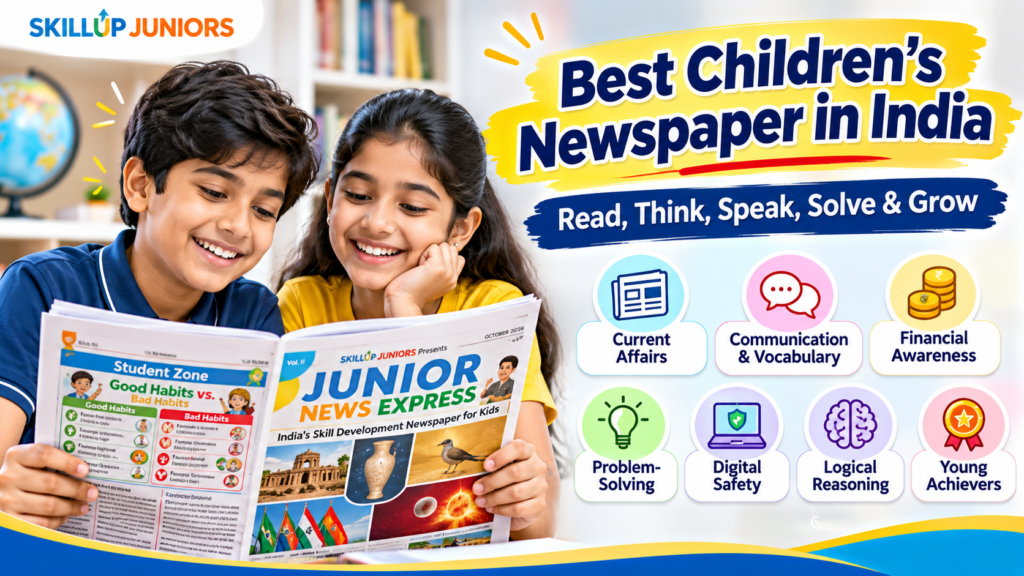
Best Children’s Newspaper in India: What Should Parents Look For?
Children today have access to more information than ever before. From smartphones and television to social media and the internet, information is everywhere. But does having access to information mean children are learning how to understand it, think independently and use it in real life?
This is an important question for parents.
Reading a newspaper designed for children can be a meaningful way to introduce them to the world beyond their classrooms. A good children’s newspaper in India can help young readers understand current affairs, improve vocabulary, develop general awareness and become more curious about the world around them.
However, not every children’s newspaper offers the same learning experience. Some focus on news and general knowledge, while others include stories, puzzles, creative activities and age-appropriate learning content.
So, how should parents choose the right newspaper for their children?
Let’s explore.
Why Should Children Read Newspapers?
Reading newspapers is not just about knowing what is happening around the world. When children read and understand age-appropriate news, they get opportunities to develop several important skills.
1. Develops General Awareness
Children begin understanding what is happening in India and other parts of the world. They learn about science, technology, sports, nature, discoveries, important events and society.
This gradually builds their awareness of the world around them.
2. Improves Reading and Vocabulary
Regular reading introduces children to new words, sentence structures and different ways of expressing ideas.
When children read regularly, they get more opportunities to improve their reading fluency, comprehension and vocabulary.
3. Encourages Critical Thinking
News can introduce children to real-world situations and different perspectives.
Instead of simply reading information, children can be encouraged to ask questions:
- Why did this happen?
- What could be the reason?
- How might this affect people?
- What would I do in this situation?
These questions help children move beyond memorising facts and start thinking independently.
4. Builds Communication Skills
When children read a story or news article and explain it in their own words, they practise expressing ideas.
Parents can encourage them to discuss one interesting news story every day. This simple habit can create opportunities to improve confidence and communication.
5. Creates a Healthy Reading Habit
A child-friendly printed newspaper can provide a screen-free reading experience.
It can become a regular family activity where parents and children read, discuss and learn together.
What Should Parents Look for in a Children’s Newspaper?
Choosing a newspaper for children should not be based only on the number of pages or the amount of information it contains.
Parents should look at the kind of learning experience it provides.
Here are seven important features to consider.
1. Age-Appropriate News and Current Affairs
Children need information presented in language they can understand.
Look for publications that explain national and international news in a simple, engaging and child-friendly manner.
2. General Knowledge and Interesting Facts
A good children’s newspaper should encourage curiosity about science, history, geography, nature, technology, sports and society.
Interesting facts and short explainers can make learning enjoyable.
3. Communication and Vocabulary Activities
Reading is only one part of language development.
Activities such as sentence formation, vocabulary challenges, role-play, speaking prompts and discussions can encourage children to use what they read.
4. Critical Thinking and Problem-Solving
Children should get opportunities to apply their thinking to everyday situations.
Case studies, reasoning questions, real-life challenges and open-ended activities can encourage them to analyse situations and suggest solutions.
5. Financial and Digital Awareness
Children are growing up in a world shaped by technology, online communication and financial decisions.
Age-appropriate content about saving money, understanding basic economic ideas, identifying suspicious online messages and practising safe digital habits can introduce valuable life skills.
6. Puzzles and Creative Activities
Word games, crosswords, picture challenges, logical reasoning activities and creative writing prompts make reading more interactive.
They also give children opportunities to participate instead of simply consuming information.
7. Opportunities for Children to Participate
A newspaper becomes more engaging when children feel that their voices matter.
Look for opportunities to submit artwork, stories, writing, achievements or creative contributions.
This can encourage children to express themselves and take pride in their work.
Popular Children’s Newspapers in India
Parents in India have several publications to explore. Each has its own approach, content style and learning experience.
Here are some examples.
1. RobinAge
RobinAge is a fortnightly children’s newspaper for young readers. Its content includes current affairs, general knowledge, science, environment, sports, finance, puzzles, games, activities and personal growth.
It also offers age-specific editions and opportunities for children to contribute their work.
It is an established option for parents looking for a combination of news, knowledge and activity-based reading.
2. KidsAge
KidsAge is a monthly children’s newspaper that offers different content segments for different age groups.
Its offerings include stories, puzzles, games, art and craft, informative articles, quizzes and special interactive editions.
It is an option for parents looking for age-segmented content and creative learning experiences.
3. The Junior Age
The Junior Age is a fortnightly children’s newspaper recommended for children aged 7–14.
It covers national and international news, sports, animals, science discoveries, special reports, entertainment and educational activities.
Its content aims to introduce children to current affairs in an easy-to-understand format.
4. Junior News Express by SkillUp Juniors
Junior News Express takes a skill-development-focused approach to children’s reading.
It is a monthly printed newspaper for children aged 8 and above. Along with child-friendly current affairs and general knowledge, it includes activities designed to encourage children to think, communicate, solve problems and apply ideas.
Its approach is built around a simple belief: children should not only read about the world; they should also learn how to understand it and respond to it.
What Makes Junior News Express Different?
Many children’s publications combine news, general knowledge, puzzles and activities. These are valuable parts of children’s reading.
Junior News Express aims to take that learning experience further by bringing different skill-building opportunities together in one publication.
Instead of treating every page as just another piece of information, its content encourages children to read, think, speak, solve and participate.
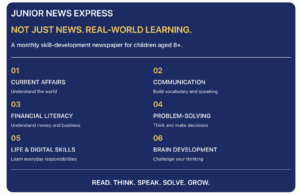
Here is what children can explore inside Junior News Express.
1. Current Affairs Explained for Young Readers
Children explore national and international developments through simplified news stories and explainers.
The aim is to help them understand important topics rather than merely memorise headlines.
2. Real-Life Problem-Solving Case Studies
Children are presented with relatable situations and questions that encourage them to think of possible solutions.
For example:
- How would you handle a forgotten school project?
- What could you do if your school faces a water shortage?
- How should you respond to a suspicious online message?
These activities encourage children to analyse situations, think logically and make thoughtful decisions.
3. Communication and Vocabulary Challenges
Children get opportunities to practise language through vocabulary activities, sentence improvement, speaking prompts and role-play.
These activities encourage them to use new words and express their thoughts more confidently.
4. Financial and Economic Awareness
Children are introduced to topics related to money, the economy, businesses and important financial concepts in a simplified way.
The objective is to build early awareness and encourage practical thinking.
5. Cyber Safety and Digital Awareness
Understanding online safety is increasingly important.
Children are introduced to basic digital safety practices, such as recognising suspicious messages, thinking before clicking links and protecting themselves online.
6. Logical Reasoning and Brain-Boosting Activities
Word searches, crosswords, mazes, picture challenges, matchstick puzzles and other reasoning activities make learning interactive.
They encourage children to observe carefully, identify patterns and work towards solutions.
7. Young Achievers and Student Participation
Children’s achievements, creativity and contributions deserve recognition.
Junior News Express provides space to celebrate young achievers and encourages children to share their writing, artwork and other creative work.
8. A Learning Experience Beyond Reading
The central idea is to connect information with practical learning.
A child may read about an environmental issue, discuss a real-life problem, practise speaking, solve a puzzle and reflect on a digital safety lesson.
This combination creates opportunities to develop multiple skills through a regular reading habit.
Children’s Newspaper Comparison: What Should Parents Consider?
There is no single newspaper that is automatically the best choice for every child. The right option depends on the child’s age, interests, reading level and learning needs.
| Publication | Key focus |
|---|---|
| RobinAge | Current affairs, general knowledge, activities, personal growth and child contributions |
| KidsAge | Age-segmented content, stories, puzzles, creative activities and special editions |
| The Junior Age | Child-friendly current affairs, science, sports, special reports and fun learning |
| Junior News Express | Current affairs combined with communication, problem-solving, financial awareness, cyber safety and reasoning activities |
Each publication offers a different reading experience. Parents should explore sample editions and decide which content best matches their child’s interests and development goals.
How Can Parents Make Newspaper Reading a Daily Habit?
Buying a children’s newspaper is only the first step. Parents can make the experience more meaningful by encouraging children to interact with what they read.
Try these simple activities:
1. Ask your child to explain one news story.
Let them explain what happened in their own words.
2. Introduce a word of the day.
Ask your child to identify one new word, understand its meaning and use it in a sentence.
3. Have a five-minute discussion.
Choose an interesting topic and encourage your child to share an opinion.
4. Encourage independent thinking.
Ask questions such as, “What would you do differently?” or “Can you think of another solution?”
5. Let your child complete the activities independently.
Give them time to solve puzzles, answer questions and explore creative challenges.
6. Celebrate their progress.
Appreciate their effort, curiosity and willingness to express ideas.
Remember, the objective is not to turn newspaper reading into another homework assignment. It should be an enjoyable learning habit.
Frequently Asked Questions About Children’s Newspapers in India
1. Which is the best children’s newspaper in India?
The best children’s newspaper depends on your child’s age, interests and learning requirements. Parents can compare publications such as RobinAge, KidsAge, The Junior Age and Junior News Express by exploring their content and sample editions.
2. At what age should children start reading newspapers?
Children can begin exploring age-appropriate reading material when they develop basic language and reading skills. Publications designed specifically for children can make the experience easier and more engaging. Junior News Express is designed for children aged 8 and above.
3. How does reading newspapers help school students?
Reading newspapers can support vocabulary, reading comprehension, general awareness, critical thinking and communication. Discussing news stories can also encourage children to express their opinions and ask questions.
4. Are children’s newspapers better than regular newspapers?
Children’s newspapers are designed to present information in a more age-appropriate and accessible way. They often include simplified news, illustrations, activities and interactive learning features. Regular newspapers may contain language and topics that require more guidance for younger readers.
5. What should a good newspaper for kids include?
A useful children’s newspaper may include current affairs, general knowledge, vocabulary, reading activities, puzzles, creative challenges, problem-solving exercises and age-appropriate life-skill content.
6. Can newspaper reading improve communication skills?
Reading alone does not automatically make a child a confident communicator. However, explaining news stories, discussing topics, learning vocabulary and practising speaking activities can create valuable opportunities to improve communication.
7. What is Junior News Express?
Junior News Express is a monthly printed newspaper by SkillUp Juniors for children aged 8 and above. It combines child-friendly current affairs and general knowledge with communication activities, problem-solving case studies, financial awareness, cyber safety, logical reasoning and creative challenges.
Final Thoughts: Choose Reading That Helps Children Grow
A children’s newspaper should do more than fill a child’s free time. It should encourage curiosity, develop reading habits and create opportunities to explore ideas beyond everyday classroom learning.
When choosing a children’s newspaper in India, parents should look beyond headlines and page counts. They should consider whether the publication encourages children to understand information, ask questions, express ideas and apply their thinking.
That is the learning philosophy behind Junior News Express.
Not just news. Real-world learning.
READ. THINK. SPEAK. SOLVE. GROW.
Explore Junior News Express by SkillUp Juniors and introduce your child to a more engaging way of learning about the world.