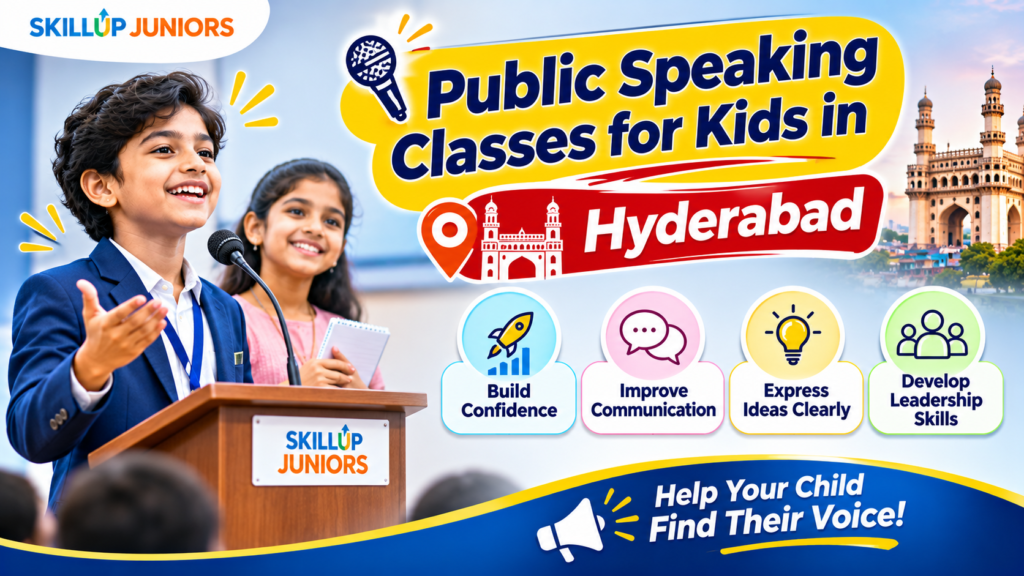
Public Speaking Classes for Kids in Hyderabad: Build Confidence and Communication Skills
Does your child feel nervous while speaking in front of classmates? Does your child know the answer but hesitate to raise a hand in class? Or does your child struggle to express thoughts clearly during conversations, presentations or group activities?
These are common challenges among school-going children.
Academic knowledge is important, but children also need the confidence to communicate their ideas, express their opinions and speak comfortably in front of others.
This is where public speaking classes for kids in Hyderabad can make a meaningful difference.
Public speaking is not just about delivering speeches on a stage. It is about developing confidence, organising thoughts, communicating clearly, listening to others and expressing ideas without unnecessary fear.
At SkillUp Juniors, we believe every child has a voice worth developing. Through communication-focused learning, storytelling, group discussions, listening activities and public speaking practice, children get opportunities to express themselves and grow.
In this guide, let’s understand why public speaking matters, what children should learn and how parents can choose the right public speaking program.
Why Are Public Speaking Classes Important for Kids?
Many children have wonderful ideas but find it difficult to communicate them. Some hesitate because they are afraid of making mistakes, while others lack opportunities to practise speaking.
Public speaking classes give children a supportive environment to practise and gradually become more comfortable expressing themselves.
Here are some important benefits.
1. Builds Self-Confidence
One of the biggest benefits of public speaking classes for kids is the opportunity to build confidence.
When children regularly practise speaking, introduce themselves, share opinions and participate in discussions, they gradually become more comfortable expressing their thoughts.
They also learn that making mistakes is a normal part of learning.
2. Improves Communication Skills
Good communication involves more than speaking fluently.
Children need to learn how to:
- Express ideas clearly.
- Use appropriate words and sentences.
- Organise thoughts before speaking.
- Listen carefully to others.
- Respond appropriately during conversations.
- Communicate their opinions respectfully.
Regular speaking activities help children practise these important abilities.
3. Reduces Stage Fear
Some children feel nervous when they stand in front of an audience. They may forget their words, speak too softly or avoid participating.
A structured public speaking program can introduce speaking activities gradually, starting with small exercises and progressing towards short speeches and presentations.
With regular practice and encouragement, children can become more comfortable speaking before others.
4. Develops Critical Thinking
Public speaking requires children to think about what they want to communicate.
When children participate in debates, group discussions and opinion-sharing activities, they learn to consider different viewpoints, organise their thoughts and explain their reasoning.
This can encourage independent thinking and better expression.
5. Improves Vocabulary and Language Expression
Children who regularly participate in storytelling, reading aloud, sentence-building and speaking exercises get opportunities to use new words in context.
They can practise forming meaningful sentences and explaining ideas in their own words.
The goal should be clear communication rather than forcing children to speak with a particular accent.
6. Encourages Leadership and Teamwork
Children often need to communicate while working with others.
Group discussions, team presentations and collaborative activities help them practise sharing responsibilities, listening to teammates and expressing their views.
These experiences can support leadership and teamwork development.
7. Prepares Children for Everyday Situations
Public speaking skills are useful beyond school competitions.
Children may need to:
- Introduce themselves to new people.
- Ask questions in class.
- Explain a project.
- Participate in group activities.
- Share their opinions.
- Give a short presentation.
- Speak confidently during an interview or competition.
Practising these situations can help children become more comfortable communicating in everyday life.
Signs Your Child May Need Public Speaking Practice
Every child develops communication skills at a different pace. Being quiet or introverted does not automatically mean a child has a communication problem.
However, parents may notice certain situations where additional speaking practice could help.
Look out for these signs:
- Your child hesitates to speak in front of classmates.
- Your child avoids participating in classroom discussions.
- Your child struggles to introduce themselves.
- Your child finds it difficult to explain ideas clearly.
- Your child speaks very softly in group situations.
- Your child feels nervous during presentations.
- Your child has ideas but finds it difficult to express them.
- Your child avoids debates, storytelling or speaking competitions.
Instead of comparing children with others, parents can create opportunities for gradual improvement.
The objective is not to change a child’s personality. It is to help the child feel comfortable expressing themselves.
What Do Children Learn in Public Speaking Classes?
A good public speaking course for kids should not focus only on memorising speeches.
Children need practical activities that help them develop different aspects of communication.
Here are some important areas a well-structured program can cover.
1. Self-Introduction
Children learn how to introduce themselves confidently by sharing their name, interests, hobbies and other relevant information.
Practice activity: Ask your child to introduce themselves in 30 seconds.
2. Voice Modulation and Clarity
Children practise speaking at an appropriate volume, pronouncing words clearly and using pauses effectively.
Practice activity: Ask your child to read a short paragraph using different expressions.
3. Body Language and Eye Contact
Communication also involves facial expressions, posture, gestures and eye contact.
Children can practise maintaining a comfortable posture and using natural gestures while speaking.
Practice activity: Ask your child to explain their favourite activity while standing comfortably.
4. Storytelling Skills
Storytelling helps children organise ideas and communicate them in an interesting way.
They learn how to introduce characters, describe events and build a beginning, middle and ending.
Practice activity: Give your child a picture and ask them to create a short story around it.
5. Extempore Speaking
Extempore activities encourage children to speak on a topic without preparing a complete speech in advance.
They help children practise thinking quickly and organising their ideas.
Practice activity: Give your child a simple topic such as “My Favourite Festival” and allow one minute to prepare.
6. Group Discussions
Group discussions encourage children to listen, share opinions and respond respectfully.
Children learn that communication is not just about speaking. It also involves understanding other people’s perspectives.
Practice activity: Discuss the topic “Should children have a daily reading habit?”
7. Debate and Opinion Sharing
Debates give children opportunities to explore different viewpoints and support their opinions with reasons.
Practice activity: Discuss “Is reading a printed book better than reading on a screen?”
8. Presentation Skills
Children practise presenting information in an organised and understandable manner.
They can learn how to begin a presentation, explain important points and conclude confidently.
Practice activity: Ask your child to give a two-minute presentation about a favourite animal, place or invention.
9. Listening and Conversation Skills
Good speakers are also good listeners.
Children should practise understanding questions, allowing others to speak and responding appropriately.
Practice activity: Ask your child to listen to a short story and explain its main message.
How to Choose the Best Public Speaking Classes for Kids in Hyderabad
Parents searching for public speaking classes for kids in Hyderabad may find several options. But before enrolling a child, it is important to understand what the program actually teaches.
Here are seven things to consider.
1. Look for Practical Speaking Opportunities
A program should give children opportunities to speak during sessions.
Watching presentations or listening to lectures alone is not enough. Children need regular opportunities to participate.
2. Check Whether the Program Is Age-Appropriate
A younger child may need storytelling, simple introductions and picture-based speaking activities.
Older children may benefit from debates, presentations, extempore speaking and structured discussions.
The teaching approach should suit the child’s age and comfort level.
3. Understand the Teaching Method
Ask whether the sessions include interactive activities, individual speaking opportunities, group discussions and constructive feedback.
Practical learning can make communication training more engaging.
4. Check the Learning Environment
Children should feel comfortable making mistakes and expressing different opinions.
A supportive environment is important for children who are hesitant to speak.
5. Ask About Progress Tracking
Parents should understand how their child’s development will be observed.
Useful indicators may include:
- Ability to introduce themselves.
- Clarity of speech.
- Organisation of ideas.
- Participation in discussions.
- Confidence during short presentations.
- Ability to listen and respond.
6. Look for Experienced and Supportive Mentors
Mentors should understand how to engage children, encourage participation and provide age-appropriate feedback.
The objective is to guide children rather than criticise them for mistakes.
7. Compare Online and Offline Learning Options
Hyderabad parents can consider both online and offline public speaking programs.
Online sessions may offer convenience and opportunities to practise speaking from home. Offline sessions may provide face-to-face interaction.
Choose the format that suits your child’s learning needs and schedule.
Public Speaking Classes for Kids in Hyderabad – Discover SkillUp Juniors
At SkillUp Juniors, we believe communication is an essential life skill that children should get opportunities to practise from an early age.
Our communication-focused learning approach encourages children to express their thoughts, participate in activities and become more comfortable communicating with others.
The learning approach includes:
- Storytelling: Encouraging children to organise ideas and communicate through stories.
- Public Speaking: Giving children opportunities to practise speaking on different topics.
- Group Discussions: Helping children share opinions and listen to different perspectives.
- Listening Activities: Developing attentive listening and thoughtful responses.
- Practical Learning: Connecting communication activities with everyday situations.
Rather than focusing only on memorised speeches, the objective is to help children practise real communication.
What Makes SkillUp Juniors’ Approach Valuable?
Learning through participation
Children get opportunities to express their own ideas instead of simply listening to explanations.
Confidence through practice
Regular speaking opportunities can help children become more comfortable communicating.
Communication beyond the classroom
Activities encourage children to use communication skills in conversations, presentations and group situations.
A supportive learning experience
Children should feel encouraged to try, make mistakes, learn and improve at their own pace.
If you are a parent looking for public speaking classes for kids in Hyderabad, explore the SkillUp Juniors communication and skill-development learning opportunities.
Visit the SkillUp Juniors website to learn more about the available programs and enrolment options.
10 Fun Public Speaking Activities Parents Can Try at Home
Public speaking practice does not have to begin on a stage. Parents can introduce simple activities at home.
1. One-Minute Speaking Challenge
Give your child a simple topic and ask them to speak for one minute.
Topics:
- My Favourite Teacher
- My Dream Holiday
- If I Could Invent Something
- Why I Love My Family
2. Talk About a Picture
Show your child a picture and ask them to describe what they see.
Encourage them to explain the people, objects, surroundings and possible story behind the picture.
3. Story Completion
Start a story with one sentence and ask your child to continue it.
This activity encourages imagination and spontaneous expression.
4. Introduce a Family Member
Ask your child to introduce a family member and explain three things they appreciate about that person.
5. News Presenter Activity
Ask your child to pretend to be a news presenter and explain a simple, age-appropriate news story.
6. Show and Tell
Let your child choose a favourite object, explain what it is and share why it is special.
7. Opinion of the Day
Choose one simple topic and ask your child to share an opinion with two reasons.
8. Word of the Day
Introduce a new word and ask your child to use it in three different sentences.
9. Role-Play
Practise everyday situations such as ordering food, asking for directions or introducing yourself to someone new.
10. Family Discussion Time
Choose one topic and allow every family member to share their opinion without interruption.
These activities can make speaking practice a natural part of everyday life.
Public Speaking Topics for School Students
Choosing the right topic can make speaking practice more enjoyable.
Here are some topic ideas for children.
For younger children:
- My Favourite Animal
- My Best Friend
- My Favourite Festival
- A Day Without Television
- My Favourite Book
For middle-school students:
- Why Is Time Management Important?
- Should Every Child Read Books?
- The Importance of Saving Water
- Is Teamwork Important?
- How Can We Protect the Environment?
For older students:
- Does Technology Make Us Smarter?
- The Importance of Financial Literacy
- Should Social Media Have Age Restrictions?
- Artificial Intelligence: Opportunities and Challenges
- Why Are Communication Skills Important for Future Careers?
Parents can encourage children to choose topics they genuinely enjoy discussing.
Frequently Asked Questions About Public Speaking Classes for Kids in Hyderabad
1. What is the right age to start public speaking classes for kids?
Children can begin practising basic communication skills at an early age through storytelling, introductions, reading aloud and simple conversations. More structured public speaking activities can be introduced according to the child’s age and readiness.
2. Are public speaking classes useful for shy children?
Yes. Public speaking practice can give shy children opportunities to express themselves gradually in a supportive environment. Children should not be forced to become extroverted; the aim is to help them communicate comfortably.
3. How do public speaking classes help school students?
They provide opportunities to practise communication, vocabulary, storytelling, listening, presentation and opinion-sharing skills. These abilities can be useful in classroom discussions, school activities and everyday conversations.
4. How long does it take for a child to improve public speaking?
There is no fixed timeline. Progress depends on the child’s starting point, opportunities to practise, learning environment and consistency. Regular practice and constructive feedback are important.
5. Can public speaking classes improve English communication?
Public speaking activities conducted in English can provide opportunities to practise vocabulary, sentence formation, pronunciation and expression. However, language fluency and public speaking confidence are related but different skills.
6. Are online public speaking classes effective for kids?
Online classes can provide useful speaking opportunities when sessions are interactive and children actively participate. Look for programs that include individual speaking practice, discussions, activities and feedback.
7. What is the difference between public speaking and communication skills?
Public speaking focuses on expressing ideas before an audience. Communication skills are broader and include everyday conversations, listening, understanding, asking questions and responding appropriately.
8. How can parents help children overcome stage fear?
Start with short speaking activities at home, encourage children to express their opinions and gradually introduce small-group speaking opportunities. Appreciate effort rather than demanding perfect performance.
9. What should parents look for in public speaking classes in Hyderabad?
Look for interactive sessions, age-appropriate activities, regular speaking opportunities, supportive mentors and a clear approach to observing progress. Ask about the session format and available learning options before enrolling.
10. Does SkillUp Juniors offer communication and public speaking learning for kids?
SkillUp Juniors includes public speaking, storytelling, group discussions, listening activities and practical learning in its communication-focused approach. Parents can visit the official website to explore current program availability and enrolment details.
Help Your Child Find Their Voice
Every child has ideas, opinions, creativity and the ability to express themselves.
Sometimes, they simply need the right opportunities, encouragement and practice.
Public speaking is not about making every child a perfect speaker. It is about helping children become more comfortable sharing ideas, communicating respectfully and expressing themselves with confidence.
If you are searching for public speaking classes for kids in Hyderabad, explore the learning approach at SkillUp Juniors.
Let your child learn to speak with confidence, think independently and express ideas clearly.
SkillUp Juniors – Building Skills. Building Confidence. Building Futures.