
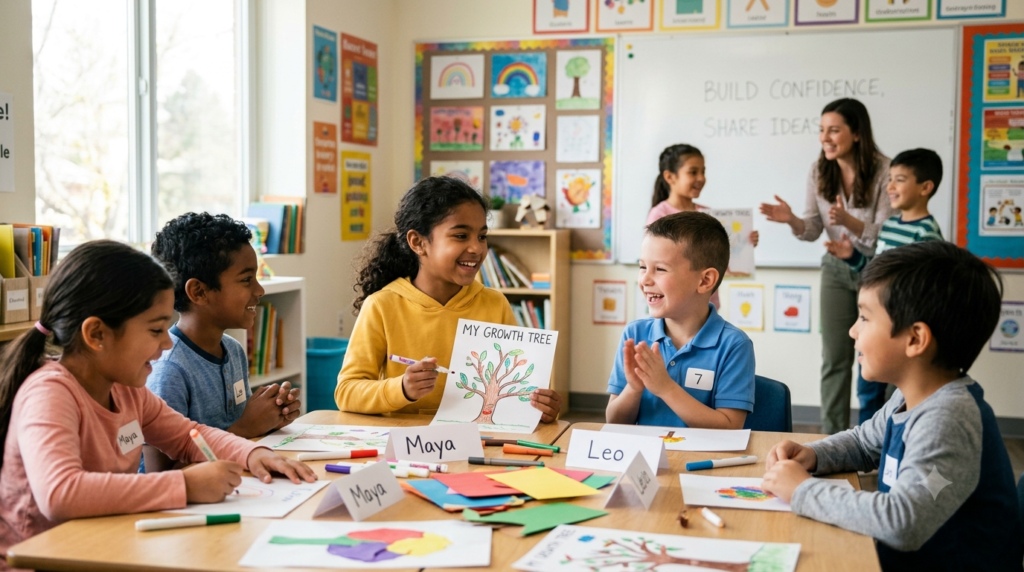
Every parent wants to raise a child who walks into a room and feels at ease, speaks up without fear, and treats people with warmth. But confidence and communication don’t always grow on their own. In classrooms packed with syllabus targets, soft skills quietly slip through the cracks. That’s exactly the gap personality development classes for kids are built to fill. At SkillUp Juniors, we’ve watched shy seven-year-olds turn into children who volunteer to lead their school assembly, and it never gets old.
Marks matter. Nobody’s arguing otherwise. But how a child expresses an idea, handles a setback, or listens to a friend shapes their life far beyond any report card. This guide walks you through why personality growth matters so much right now, what happens inside a good online program, and the simple habits you can start building at home today.
Why Personality Development Matters More Than Ever
We live in a world that runs on communication. Children who can think clearly, speak with conviction, and connect with others emotionally simply stand out — in school, in friendships, and later in their careers. A strong personality gives a child the courage to raise their hand, take initiative, and bounce back when things don’t go their way.
Here’s what early skill-building tends to shape:
- Confidence to voice an opinion in class or in front of a group
- Leadership instincts for teamwork and everyday decision-making
- Empathy and emotional intelligence that fuel healthy friendships
- Adaptability and problem-solving when situations shift unexpectedly
When families invest in this early, they aren’t just adding skills to a résumé. They’re building character. And honestly, character is the thing that stays long after the multiplication tables fade.
A good personality development course for kids treats these traits as teachable — not fixed at birth. That single shift in thinking changes everything about how a child grows.
How Online Personality Development Classes Help Kids Thrive
Parents ask us this all the time: “Can personality really be taught over a screen?” Fair question. The answer is yes — provided it’s taught the right way.
Effective personality development classes for kids lean on interactive learning, one-to-one attention, and activity-based sessions that feel more like play than instruction. A skilled mentor reads each child’s pace and builds a space where they feel safe enough to open up. That safety is where real growth begins.
At SkillUp Juniors, our sessions typically cover:
- Public speaking and communication: finding clarity, tone, and rhythm in how they speak
- Confidence-building exercises: shrinking stage fright and hesitation, one small win at a time
- Body language and expression: understanding how a gesture or posture changes the message
- Leadership and team play: encouraging initiative, fairness, and decision-making
Children learn through storytelling, games, and real examples — never dull repetition. That’s the difference between a child who memorises a speech and a child who actually enjoys giving one.
This is also why online personality development training for students works so well when it’s live and personal. A recorded video can’t notice when a child hesitates. A real coach can.
Personality Development Activities for Kids: Small Habits, Big Change
You don’t need a formal setup to start shaping your child’s personality. Some of the most powerful growth happens through five-minute habits at the dinner table. Here are a few activities that build confidence and self-expression at home:
- Story-building challenge: hand your child a random object — a spoon, a sock, a torch — and ask them to invent a short story around it. Sparks imagination and verbal fluency.
- Mirror talk: have them speak three sentences to their own reflection each day. Sounds silly, works wonders for self-belief.
- Decision day: let your child pick one family activity each weekend. Small choices grow into real responsibility.
- Compliment journal: every night, jot down one good thing they did. Builds self-awareness and kindness.
- Emotion charades: act out feelings and guess them together. A playful way to decode emotions and grow empathy.
Do these consistently and something quietly shifts. Shyness loosens into expression. Hesitation hardens into confidence. It’s not magic — it’s repetition with love behind it.
Don’t wait to nurture your child’s confidence and self-belief. Book a free demo with SkillUp Juniors and watch the change begin.
Building Confidence Step by Step
Confidence doesn’t arrive in one big moment. It’s stacked from tiny daily wins. Children build it when they feel heard, encouraged, and celebrated for trying — not just for getting things right.
Here’s how you can help at home:
- Create speaking chances: let them introduce a guest or share a story at dinner
- Celebrate the effort: swap “That’s wrong” for “I love how you tried that”
- Skip comparisons: every child moves at their own pace, full stop
- Allow safe failures: mistakes are where the real learning lives
Confidence blooms where support meets exposure. That’s the quiet strength of a structured personality development course for kids — it hands the child a guided stage to express themselves without fear of being judged.
Think about the last time your child hesitated before answering a question they clearly knew. That pause isn’t a lack of knowledge — it’s a lack of certainty that their voice matters. Fix the certainty, and the knowledge flows freely. Every time a child speaks and gets a warm response, a little brick of self-belief settles into place. Enough bricks, and you have a wall that holds steady even under pressure.
Communication Skills for Kids: The Foundation of Expression
Strong communication isn’t about speaking flawless English. It’s about expressing thoughts clearly and listening with genuine attention. Two very different things, and both need practice.
Good communication training usually covers:
- Voice modulation: knowing when to speak softly and when to project
- Articulation: speaking with clarity so ideas actually land
- Active listening: responding thoughtfully instead of just waiting for a turn to talk
- Empathy in conversation: reading the emotion and tone behind words
Our communication modules use storytelling, friendly debate games, and expressive reading to strengthen these habits over time. Try this at home tonight: ask your child to share one story or idea aloud for three minutes. Listen, smile, and gently guide their clarity only after they finish. Done regularly, this small ritual builds fluency faster than any worksheet.
Leadership Skills for Children: Teaching Initiative Early
Leadership isn’t about barking orders. For children, it’s really about collaboration, making decisions, and owning the outcome. These are muscles, and they strengthen with use.
Structured classes train leadership through interactive challenges, but you can plant the seeds at home:
- Hand over small responsibilities: let your child plan a weekend outing
- Set up team scenarios: “You’re the captain today — who does what?”
- Talk about real leaders: discuss what makes someone fair and trustworthy
- Encourage group speaking: story circles, mini presentations, sibling debates
Kids who practise leadership young learn to stay calm, think clearly, and bring others along with them. That’s a foundation that pays off for life.
Ready to help your child grow into a confident young leader? Explore SkillUp Juniors’ Skill Development Program built around exactly this.
The Role of Parents in Personality Development
Here’s a truth that surprises some families: you are the single biggest influence on your child’s personality. Long before any mentor steps in, the way you respond, listen, and engage teaches your child how to see themselves.
A few ways to make that influence count:
- Model it: speak politely, stay positive, show empathy in your own actions
- Encourage independence: let them make small decisions, even the imperfect ones
- Stay consistent: replace criticism with curiosity — “What made you think that?”
- Balance the screen: protect time for real conversation and creative play
A child who feels safe expressing themselves at home carries that same confidence into the classroom and the playground. It travels with them.
Tracking Growth: Signs of Progress to Look For
You’ll often spot changes within just a few weeks of consistent effort. Keep an eye out for:
- More open body language and steadier eye contact
- Less hesitation when facing something new
- Better emotional control during disagreements
- Independent decisions and a growing sense of curiosity
A simple trick: keep a small “growth journal.” Once a week, note one new skill or shift you’ve noticed. It helps you measure confidence in a way grades never could. Parents who track this way tend to stay more patient, because progress becomes visible.
Why SkillUp Juniors’ Approach Works
Our personality development classes for kids are built on one plain idea — learning by doing. Children don’t just sit and listen. They participate, present, and reflect. Every live one-to-one session flexes around your child’s comfort level and pace, because no two children are the same.
Our programs blend:
- Real-world scenarios that mirror everyday situations
- Activity-based learning that keeps energy high
- Positive reinforcement that rewards effort
- Personalised feedback after each session
That structure means children don’t just learn a skill and forget it. They absorb it until it becomes part of who they are. This is what quality personality development training for students should always aim for — not performance, but genuine growth.
Common Mistakes Parents Should Avoid
Even the most caring parents slip into a few traps. Watch for these:
- Over-coaching: let the mentor lead; too much correction shrinks a child’s self-expression
- Expecting instant change: personality grows through practice, not pressure
- Ignoring small wins: every attempt counts, so celebrate the process, not only the result
- Skipping consistency: ten focused minutes daily beats one long lecture a week
Think of confidence as a garden. It needs steady sunlight — your encouragement — and regular water — practice. Neglect either one and growth stalls.
Bringing It All Together: The Home and Class Connection
The strongest results show up when parents and mentors pull in the same direction. Classes provide the structure; home gives the real-life reinforcement. One without the other only goes so far.
A rhythm that works well for many families:
- Weekdays: 10 to 15 minutes of light practice at home
- Weekends: one live SkillUp Juniors session for feedback and exploration
- Monthly: a small project — a short speech, a story video, a leadership challenge
This kind of routine keeps the whole journey exciting, measurable, and genuinely joyful. A dependable personality development course for kids fits neatly into family life rather than fighting against it.
What a Typical Class Actually Looks Like
Parents picture all sorts of things when they hear “online class” — a child staring blankly at a screen, a teacher droning through slides. A well-run session looks nothing like that. It’s alive.
A typical session opens with a warm-up: a quick game, a riddle, or a “tell me about your day” chat that eases the child in. From there the mentor moves into the day’s focus — maybe voice modulation, maybe a short impromptu speech, maybe a role-play where the child pretends to interview a favourite cricketer. The child is talking, moving, thinking on their feet the whole time.
Then comes the reflection. The mentor points out one thing the child did brilliantly and one thing to try next time. Just one. Overloading a child with corrections is the fastest way to crush their spark, and good coaches know it. The session ends with a small “home mission” — a tiny challenge to practise before the next class.
That loop — practise, reflect, gently stretch — repeats week after week. It’s unremarkable in any single session. Across three months, it’s transformative. This steady rhythm is why thoughtful personality development training for students consistently outperforms one-off workshops or motivational talks that fade by the weekend.
The Emotional Side Nobody Talks About
Most conversations about child development fixate on visible skills — speaking, presenting, leading. But underneath all of that sits emotional regulation, and it rarely gets the spotlight it deserves.
A child who can name what they’re feeling handles frustration far better than one who can’t. When a child learns to say “I’m nervous” instead of shutting down, half the battle is already won. Good personality work weaves emotional literacy into every activity: naming feelings, sitting with disappointment, celebrating a friend’s win without envy.
These aren’t soft, optional extras. They’re the bedrock. A confident presenter who falls apart at the first criticism hasn’t really grown. Emotional steadiness is what makes every other skill stick, and it’s woven quietly through everything we do at SkillUp Juniors.
Comparing Learning Formats
Parents often weigh online sessions against traditional coaching. Here’s a quick side-by-side:
| Feature | Online One-to-One | Group Classroom Coaching |
| Personal attention | High — tailored to one child | Limited — split across many |
| Pace flexibility | Adjusts to the child | Fixed for the whole group |
| Comfort for shy kids | Safe, low-pressure space | Can feel intimidating |
| Progress tracking | Detailed, individual feedback | General, class-wide |
| Convenience | Learn from home | Travel required |
What Skills Develop at Each Stage
Personality growth looks different across age groups. This helps set realistic expectations:
| Age Group | Primary Focus | Typical Outcome |
| 5–7 years | Self-expression and comfort | Speaks up without fear |
| 8–10 years | Communication and empathy | Holds clear conversations |
| 11–13 years | Leadership and initiative | Leads teams and projects |
Both online personality development classes and steady home practice adapt to whichever stage your child is in right now.
Conclusion
Raising a confident child was never about pushing them to perform. It’s about giving them the space, the skills, and the steady encouragement to grow into themselves. With the right activities, mindset, and guidance, personality development becomes a natural thread woven through everyday life rather than one more thing on the to-do list.
SkillUp Juniors’ personality development classes for kids make that journey structured, inspiring, and deeply rewarding. Through interactive sessions and expert mentorship, your child learns to communicate with confidence, lead with empathy, and express themselves proudly. A thoughtful personality development course for kids doesn’t just teach behaviour — it shapes the person your child is becoming.
Don’t wait to give your child the lifelong gift of confidence and self-expression. Book a free SkillUp Juniors demo today and watch them grow into their best self.