
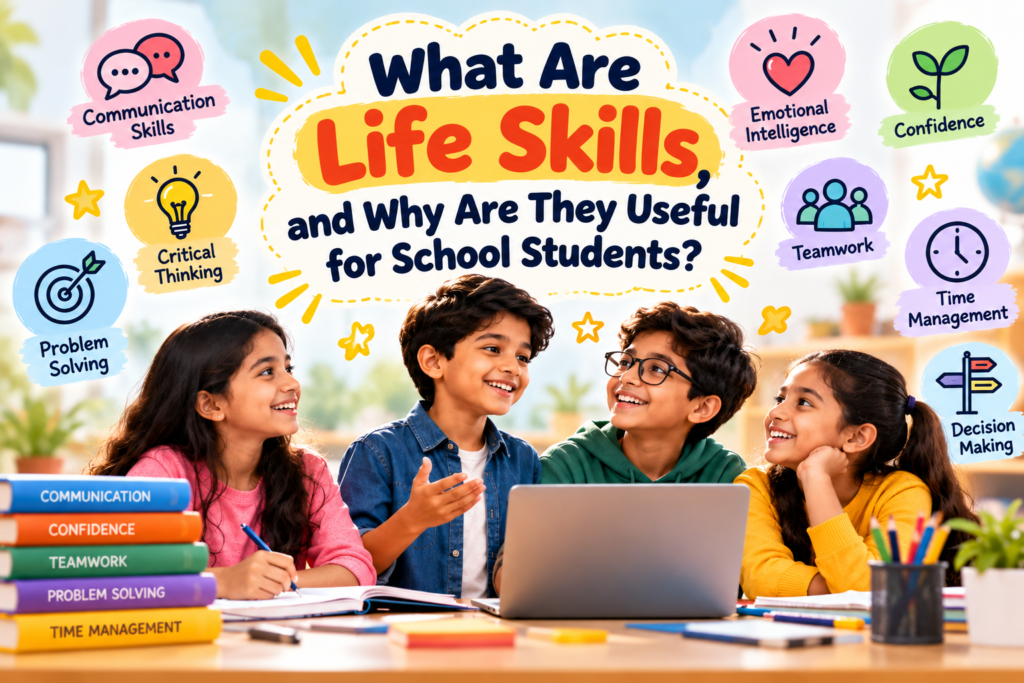
What Are Life Skills, and Why Are They Useful for School Students?
Understanding what are life skills helps parents recognise the practical abilities children need to succeed in school and everyday life.
Life skills are essential abilities that help children think independently, communicate effectively, solve problems, manage emotions, and make responsible decisions. For school students, learning life skills is important because education is not only about academic knowledge but also about preparing children to handle everyday situations with confidence.
In today’s fast-changing world, students need more than good marks to succeed. They need communication skills, critical thinking, creativity, emotional intelligence, teamwork, and self-management. Developing these abilities from an early age helps children become confident learners and responsible individuals.
At SkillUp Juniors, life skills development focuses on helping children apply what they learn to real-life situations through practical activities, interactive sessions, discussions, and experiential learning.
What Are Life Skills?
Life skills are the practical, social, emotional, and thinking abilities that help individuals deal effectively with the challenges and demands of everyday life.
For school students, life skills include learning how to express ideas clearly, understand other people’s feelings, make thoughtful decisions, manage time, overcome challenges, and work well with others.
For example, when a student confidently presents an idea in class, resolves a disagreement with a friend, or plans their homework independently, they are using life skills.
Unlike memorising information, life skills education helps children apply their knowledge in real-world situations.
Understanding What Are Life Skills in Everyday Life
When exploring what are life skills, it is important to understand that these abilities are not limited to classrooms or textbooks. Life skills are used in everyday situations, such as talking to friends, solving disagreements, managing time, making choices, and handling new experiences.
For school students, understanding what are life skills means learning how to respond to real-life situations with confidence, responsibility, and a positive attitude. These abilities help children become more independent and prepare them to handle different challenges as they grow.
For example, a child who plans a daily study schedule, listens carefully to a classmate, or calmly handles a mistake is practising important life skills. Such experiences show children how to apply their learning beyond academic subjects.
Why Are Life Skills Useful for School Students?
Life skills are useful for school students because they support personal growth, social development, emotional well-being, and practical problem-solving. These abilities help children navigate school life, build healthy relationships, and prepare for future responsibilities.
Here are seven important benefits of life skills for children.
1. Improves Communication Skills
Communication is one of the most important life skills for students. It helps children express their thoughts, ask questions, listen carefully, and share ideas confidently.
Students with good communication skills can participate more actively in classroom discussions, give presentations, interact with teachers, and build positive relationships with classmates.
Example: A student who explains an answer confidently during a classroom discussion is practising effective communication.
2. Builds Confidence and Self-Esteem
Confidence helps children believe in their abilities and attempt new challenges without being overly afraid of making mistakes.
Life skills activities such as public speaking, group discussions, storytelling, and presentations give students opportunities to practise expressing themselves in a supportive environment.
Over time, these experiences can help children become more comfortable sharing their ideas and accepting constructive feedback.
3. Develops Critical Thinking and Problem-Solving Skills
Children encounter different challenges every day, from solving difficult questions to managing disagreements with friends.
Critical thinking helps students evaluate information, ask meaningful questions, identify solutions, and make logical decisions.
Problem-solving activities encourage children to explore different approaches instead of giving up when something becomes difficult.
Example: When a student divides a large assignment into smaller tasks and completes them one by one, they are using problem-solving and planning skills.
4. Strengthens Emotional Intelligence
Emotional intelligence is the ability to recognise, understand, and manage emotions while responding thoughtfully to the feelings of others.
Students who practise emotional awareness can gradually learn to handle disappointment, manage frustration, respond calmly to disagreements, and seek help when needed.
These abilities can support healthier friendships, better classroom interactions, and improved emotional self-management.
5. Encourages Teamwork and Collaboration
Teamwork teaches students to listen to different opinions, share responsibilities, respect others, and work towards a common goal.
Group projects, team challenges, debates, and collaborative games provide opportunities to develop these abilities.
Learning to cooperate also helps children understand that different people have different strengths and perspectives.
6. Improves Time Management and Responsibility
Time management helps students balance homework, extracurricular activities, hobbies, and rest.
When children learn to prioritise tasks, follow routines, organise their belongings, and meet deadlines, they gradually become more independent.
Parents can encourage these skills by allowing children to manage age-appropriate responsibilities instead of completing every task for them.
7. Prepares Students for Future Success
Life skills are useful beyond school. Communication, adaptability, decision-making, financial awareness, creativity, and leadership can help students navigate higher education, future careers, and everyday responsibilities.
Developing these abilities early gives children more opportunities to practise and improve as they grow.
Life skills do not guarantee success, but they can equip students with valuable tools for approaching challenges and making informed choices.
What Are Life Skills and How Do They Help Children Grow?
Parents often ask what are life skills and how these abilities can benefit their children’s future. Life skills help children develop practical habits that support learning, relationships, and personal growth.
When students practise life skills regularly, they get opportunities to improve their communication, think independently, understand emotions, and make thoughtful decisions. These abilities can also help children become more comfortable working in groups, accepting feedback, and learning from mistakes.
Understanding what are life skills also helps parents recognise that children’s development involves more than academic achievement. Confidence, empathy, responsibility, creativity, and adaptability are valuable abilities that children can practise at home, at school, and in their communities.
What Are the Most Important Life Skills for School Students?
Children need a combination of thinking, emotional, social, and practical skills. The following are some of the most useful life skills for students from primary school through secondary school.
| Life skill | How it helps students |
|---|---|
| Communication | Expresses thoughts clearly and listens effectively |
| Critical thinking | Evaluates information and questions assumptions |
| Problem-solving | Finds practical solutions to challenges |
| Creative thinking | Generates original ideas and explores possibilities |
| Decision-making | Considers choices and their consequences |
| Emotional management | Recognises and regulates emotions |
| Empathy | Understands and respects other people’s feelings |
| Teamwork | Cooperates with others to achieve shared goals |
| Time management | Organises tasks and uses time effectively |
| Leadership | Takes initiative and supports a group |
| Adaptability | Adjusts to new situations and changes |
| Financial literacy | Understands basic money management and responsible spending |
| Digital awareness | Uses technology thoughtfully and recognises online risks |
| Self-awareness | Understands personal strengths, interests, and areas for improvement |
These skills can be developed gradually through age-appropriate activities, regular practice, and positive guidance from parents and teachers.
How Can Students Develop Life Skills at School?
Schools provide many opportunities to develop life skills through everyday learning experiences. Practical activities can make these abilities easier for students to understand and practise.
Classroom discussions and debates
Discussions help students organise their thoughts, listen to opposing viewpoints, explain their reasoning, and communicate respectfully.
Public speaking and storytelling
Speaking activities help children practise clear expression, confidence, audience awareness, and presentation skills.
Group projects and team challenges
Collaborative projects encourage students to share ideas, divide responsibilities, solve problems, and complete tasks together.
Role-play and real-life scenarios
Role-playing everyday situations helps students practise conflict resolution, empathy, decision-making, and appropriate communication.
Creative activities and problem-solving games
Puzzles, brain games, creative writing, and design challenges encourage logical reasoning, imagination, persistence, and independent thinking.
Financial literacy activities
Simple budgeting exercises, savings challenges, and discussions about needs versus wants introduce students to responsible money management.
Reflection and goal-setting
Encouraging students to reflect on their experiences, recognise their strengths, and set achievable goals supports self-awareness and personal development.
Practical Life Skills Activities for School Students
One of the best ways to understand what are life skills is to see how children practise them through activities. Practical learning gives students opportunities to use their abilities instead of simply reading about them.
Here are some useful life skills activities for school students:
- Public speaking: Students prepare short speeches and present their ideas to classmates.
- Team challenges: Children work together to complete a task and share responsibilities.
- Problem-solving games: Puzzles and brain teasers encourage logical and creative thinking.
- Role-playing: Students practise resolving disagreements and communicating respectfully.
- Time-management challenges: Children create a simple daily schedule and track their progress.
- Decision-making exercises: Students compare different choices and discuss possible outcomes.
These activities demonstrate what are life skills in practice and help children understand how communication, teamwork, decision-making, and problem-solving are used in real life.
How Can Parents Teach Life Skills at Home?
Parents play an important role in helping children practise life skills outside the classroom. Small, consistent opportunities at home can make learning practical and meaningful.
Here are six simple ways parents can encourage life skills development:
- Encourage independent decisions: Let children choose between suitable options and explain their reasoning.
- Give age-appropriate responsibilities: Ask children to organise their schoolbags, manage their study schedules, or help with household tasks.
- Practise active listening: Give children time to express their thoughts without immediately correcting or interrupting them.
- Discuss everyday problems: Ask questions such as, “What could you do differently next time?” to encourage independent thinking.
- Teach emotional awareness: Help children identify their feelings and discuss healthy ways to respond.
- Celebrate effort and progress: Recognise persistence, kindness, improvement, and responsible behaviour, not only academic results.
Parents should remember that life skills develop through practice. Children need opportunities to make age-appropriate choices, learn from mistakes, and try again with guidance.
What Is the Difference Between Academic Skills and Life Skills?
Academic skills and life skills serve different but complementary purposes in a child’s development.
| Academic skills | Life skills |
|---|---|
| Focus on subject knowledge and academic learning | Focus on applying abilities in everyday situations |
| Include reading, writing, mathematics, and science | Include communication, empathy, decision-making, and problem-solving |
| Often assessed through tests and assignments | Often demonstrated through behaviour, activities, and real-life tasks |
| Help students understand concepts | Help students use knowledge effectively and responsibly |
Both are valuable. Academic learning provides knowledge, while life skills help students apply that knowledge, interact with others, and manage everyday challenges.
Why Is Life Skills Education Important in India?
Life skills education is relevant for school students in India because children need opportunities to develop communication, independent thinking, collaboration, emotional awareness, and responsible decision-making alongside academic learning.
The National Education Policy (NEP) 2020 emphasises holistic development, critical thinking, experiential learning, and the development of relevant skills. Life skills activities can complement these broader educational goals when they are integrated appropriately into classroom learning.
For students in Classes 1 to 10, age-appropriate life skills activities can help make learning more interactive and connected to everyday experiences.
Schools, parents, and educational programmes can work together to provide children with opportunities to practise these abilities in a supportive environment.
How SkillUp Juniors Helps Children Develop Life Skills
SkillUp Juniors offers a Junior Skill Development Program designed to help school students develop practical abilities beyond textbook learning.
Through interactive sessions, activities, discussions, and guided practice, students can explore essential areas of personal and social development, including:
- Communication and public speaking
- Critical thinking and problem-solving
- Creative thinking and teamwork
- Confidence and self-expression
- Decision-making and responsible behaviour
- General awareness and practical learning
The aim is to provide children with opportunities to practise important skills, participate actively, and gradually become more confident in handling everyday situations.
Life skills development is an ongoing process. Regular practice, supportive guidance, and meaningful learning experiences can help children strengthen these abilities over time.
Parents looking for ways to support their child’s overall development can explore the SkillUp Juniors Junior Skill Development Program to learn more about its learning approach and activities.
Frequently Asked Questions About Life Skills for School Students
1. What are life skills in simple words?
Life skills are abilities that help people manage everyday situations effectively. Examples include communication, problem-solving, time management, decision-making, teamwork, and managing emotions.
2. Why are life skills important for school students?
Life skills help students communicate clearly, build confidence, manage responsibilities, solve problems, understand emotions, and develop positive relationships. They also help students prepare for challenges beyond the classroom.
3. What are the five most important life skills for children?
Five essential life skills for children are communication, problem-solving, critical thinking, emotional management, and decision-making. Teamwork, empathy, and time management are also valuable.
4. At what age should children start learning life skills?
Children can begin developing basic life skills in early childhood. Simple activities such as sharing, listening, expressing feelings, following routines, and making small decisions can be introduced early and adapted as children grow.
5. Can life skills improve academic performance?
Life skills may support academic learning by helping students organise their time, participate in discussions, manage frustration, collaborate with classmates, and approach challenging tasks more effectively. Results vary depending on the student and learning environment.
6. How can schools teach life skills effectively?
Schools can teach life skills through discussions, debates, role-playing, group projects, creative activities, problem-solving exercises, and reflection. Regular opportunities to practise these skills are important.
7. What is life skills education?
Life skills education is a learning approach that helps students develop the thinking, social, emotional, and practical abilities needed to handle everyday challenges and make informed decisions.
8. How can parents develop life skills in children at home?
Parents can encourage independent decision-making, assign age-appropriate responsibilities, discuss everyday problems, model respectful communication, teach basic money management, and help children understand their emotions.
9. What are life skills needed for students in daily life?
Life skills help students communicate with others, organise their time, solve everyday problems, manage emotions, and make responsible decisions. These abilities are useful at school, at home, and in social situations.
10. What are life skills examples for primary school children?
Examples include sharing, listening, expressing feelings, following routines, keeping belongings organised, asking for help, and making simple decisions independently.
11. What are life skills for teenagers?
Important life skills for teenagers include critical thinking, financial literacy, emotional management, communication, time management, digital safety, decision-making, and career awareness.
12. How can life skills education benefit children?
Life skills education provides opportunities for children to practise practical abilities through activities, discussions, teamwork, and real-life scenarios. It can support confidence, independence, social development, and responsible decision-making.
13. What Are Life Skills Examples for School Students?
Examples of life skills for school students include communication, critical thinking, creativity, emotional management, teamwork, time management, and responsible decision-making.
Why Should Parents Focus on Life Skills Development?
Understanding what are life skills can help parents support their children’s development in meaningful ways. Children need opportunities to express themselves, make age-appropriate decisions, learn from mistakes, and develop healthy relationships.
Life skills development should be a continuous process rather than a one-time lesson. Parents can encourage children to practise communication during family conversations, responsibility through simple household tasks, and problem-solving when everyday challenges arise.
For school students, these experiences can build a foundation for independence, adaptability, and responsible behaviour. By combining academic learning with practical experiences, families can help children develop abilities that are useful throughout life.
SkillUp Juniors supports this approach through its Junior Skill Development Program, which provides opportunities for children to practise essential skills through interactive learning and guided activities.
Conclusion: Help Your Child Learn Skills for Life
Life skills are an important part of a child’s overall development. They help students communicate confidently, think critically, manage emotions, work with others, and approach everyday challenges with greater independence.
By combining academic learning with practical life skills education, parents and schools can help children develop abilities that remain useful throughout their lives.
Every child deserves opportunities to learn not just what to think, but how to think, communicate, decide, and act responsibly.
Explore SkillUp Juniors to discover learning opportunities that support your child’s confidence, practical abilities, and overall development.
Knowing what are life skills and why they are useful for school students helps parents make informed choices about their children’s overall development.